Overview
The Genesys is a marketplace for 3D designs where the purchase doesn't end with a download — it ends with a physical object. A creator uploads a model. A buyer pays for the right to print it. The platform slices that model in the cloud, encrypts the result, and streams it to a small Linux hub sitting next to the buyer's printer. One click, and a machine in someone's room starts moving.
I co-led the build and worked across most of it: the Node.js services, the React creator platform, identity and service-to-service auth, the slicing pipeline, the on-chain rights layer, and the IoT side all the way down to the device. The WordPress storefront and the DevOps platform belonged to other people on the team — I have commits in the Flutter app, but it was never my strongest surface.
Why it's harder than it sounds
A dozen services have to trust each other. Once the system is more than one process, "is this request allowed?" stops being a question about users and starts being a question about services. A network boundary isn't an answer when everything shares a cluster.
The last mile runs through someone's house. A creator's model is the entire value of the product, and the final step of every transaction is putting a file on hardware we don't own and can't inspect. That constraint shaped more of the design than anything else.
Slicing is not a request-response workload. Turning an STL into printer instructions is minutes of CPU, not milliseconds, and demand arrives in bursts whenever a design does well. Anything modelled as a synchronous endpoint would have fallen over.
Nobody is ever going to touch the devices again. Once a hub ships, the only way to fix it is over the network, and a bad update means a dead box in a stranger's home with no console and no one to press reset.
One purchase, end to end
Everything below is a zoom-in on one of these steps:
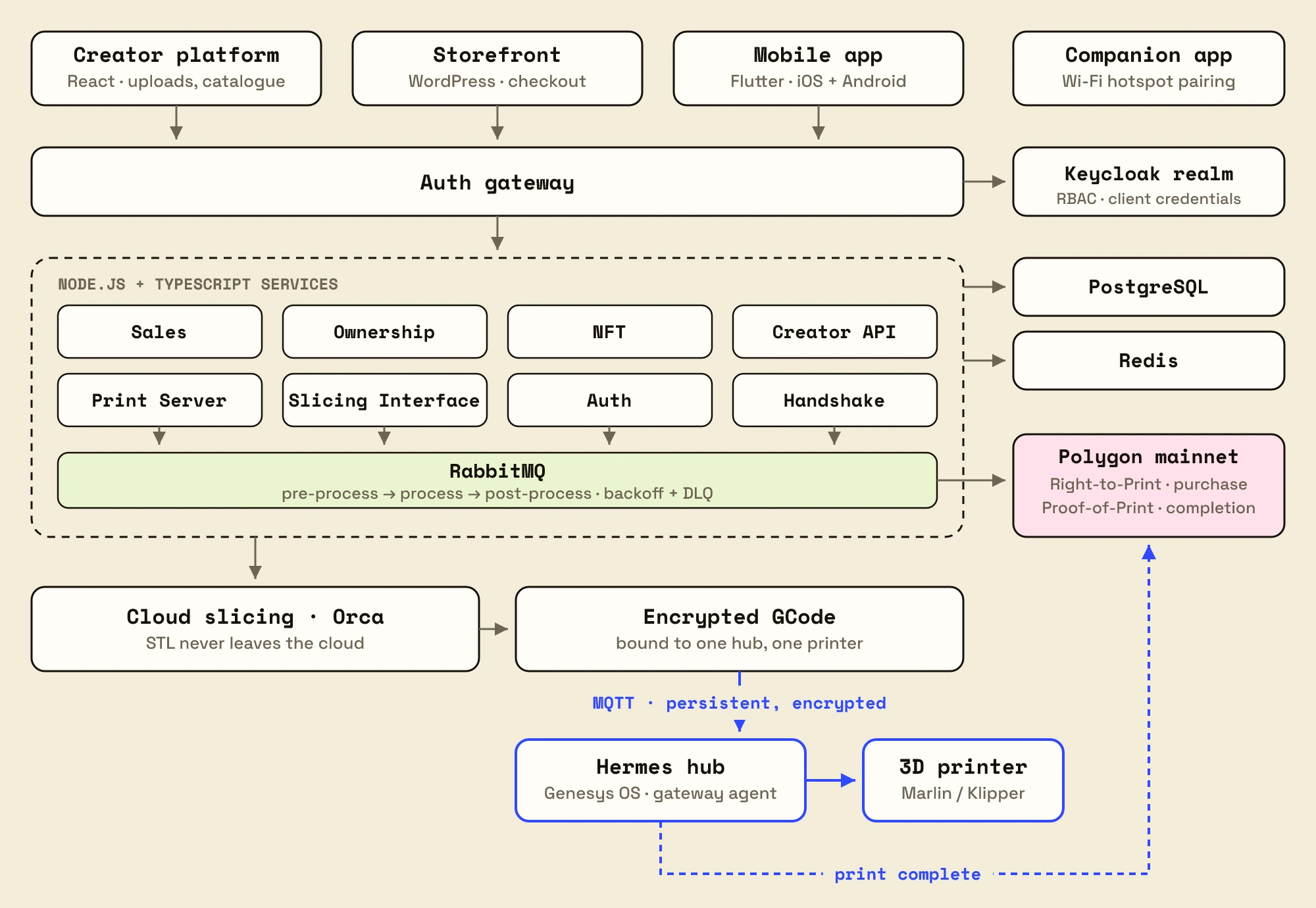
- A buyer checks out on the storefront. The Sales service reconciles the payment and emits a purchase event.
- The NFT service mints a Right-to-Print token — the buyer now provably owns a print entitlement, and it's theirs to hold or transfer.
- The Slicing Interface queues a job against the profile of the specific printer the buyer's hub is bound to. The STL itself stays in the cloud.
- The slicer produces GCode for that one printer. It's encrypted for that one hub, and the Print Server hands it off.
- The hub pulls the job over its MQTT connection, decrypts it in the gateway agent, and feeds the printer.
- Status streams back while it runs. On completion, a Proof-of-Print token is minted against the original entitlement.
The interesting property is that no single step holds the whole secret. The storefront never sees GCode, the hub never sees an STL, and the chain never sees either.
The services
A Node.js and TypeScript monorepo, deployed as separate services:
| Service | Owns |
|---|---|
| Creator API | Model uploads, metadata, the creator-facing catalogue |
| Sales | Checkout, payment reconciliation across providers |
| Ownership | Who holds what entitlement, and what state it's in |
| NFT | Minting and reading the on-chain rights records |
| Slicing Interface | Job intake, printer profiles, slicer orchestration |
| Print Server | Job delivery, device job state, status ingest |
| Auth | The gateway everything else authenticates through |
| Handshake | Key registration and signature verification between services |
Alongside them: Keycloak for identity, RabbitMQ for the async spine, Redis for hot state, and Postgres for everything durable.
There are two ways for one service to reach another. Synchronously, over internal REST with JWTs carrying service-level scopes — used when a caller genuinely needs an answer before it can continue. Asynchronously, over RabbitMQ, for everything else. The async path runs as a three-layer pipeline: a pre-process stage that validates and rejects early, a process stage that does the real work, and a post-process stage for side effects that shouldn't be able to fail the main job. Failures retry with exponential backoff and land in a dead-letter queue rather than disappearing.
Splitting side effects into their own stage was one of those decisions that looked fussy on a whiteboard and paid for itself repeatedly. A flaky notification should never roll back a print.
Zero-trust between services
Every service generates a keypair at boot and registers its public key with the Handshake service. From then on, each outbound internal call carries two things: a Keycloak-issued server token, and a signature over the request made with the caller's private key. The receiver verifies the signature against the registered public key before it does any work at all.
It means a leaked token isn't enough on its own, and a service that somehow gets into the cluster without being enrolled can't talk to anything. Getting the boot ordering right — a service that comes up before Handshake, or after a key rotation — was more of the work than the crypto was.
Identity in one place
One Keycloak realm covers everyone: buyers, creators, admins, and the services themselves. Roles and permissions live there rather than being re-implemented per service, each service is registered as a client with its own scopes, and machine-to-machine auth uses OAuth 2.0 client credentials.
The rule we held to was that only the auth gateway talks to Keycloak directly. Every other service takes a validated identity from the gateway and trusts the scopes on it. Twelve services each holding their own Keycloak integration is twelve places for an auth bug to live.
Keeping the model out of the buyer's hands
This is the problem the whole platform is arranged around. A creator's STL is the asset. If it can be extracted from a device, there is no marketplace.
Slicing in the cloud
The usual desktop workflow — download the model, slice it locally, print — was never an option, because it hands the source file to the buyer. So slicing moved server-side: Orca Slicer runs in the cloud against a profile for the exact printer the job is destined for, and only the output travels.
That output is single-purpose by construction. GCode is a stream of movements for one machine with one set of parameters; it isn't a model, and you can't meaningfully re-derive one from it. It's encrypted for the target hub, so a job lifted off the wire or off the device's storage is inert anywhere else.
Because slicing is slow and bursty, jobs go through the queue rather than an endpoint, and the interface service tracks job state so the buyer sees progress instead of a spinner.
Rights on-chain
Two Solidity contracts on Polygon mainnet hold the record. Right-to-Print is minted at purchase and represents the entitlement itself — it's a real token, so it can be held, transferred, or resold rather than being a row in our database that only we can see. Proof-of-Print is minted when a print actually completes, which gives creators a tamper-evident record of what was made from their work.
Putting entitlements on-chain also made the ownership question cleaner internally: the chain is the source of truth about what someone is allowed to print, and the services read from it rather than each keeping their own opinion.
The edge: Hermes
Hermes is the hub — an off-the-shelf single-board computer running Genesys OS, a version-controlled Linux image we build rather than a machine someone configures by hand. Every hub in the field runs a known image at a known version.
Onboarding happens over a hotspot: the hub brings up its own network, the mobile app hands it Wi-Fi credentials, and it registers itself. From that point it's bound to one printer by hardware address, which is what makes "encrypt this job for this device" meaningful.
The Printer Gateway Agent is the part that actually drives hardware, and it speaks two dialects, because the printer world hasn't settled on one:
- Marlin printers, through the local OctoPrint REST API
- Klipper printers, over a WebSocket connection
The agent also handles job decryption, file lifecycle on a device with very little storage, and streaming status back up. A process supervisor sits underneath it all and restarts anything that dies, because the alternative is asking a customer to unplug their printer.
This was the part of the project that taught me the most. Physical hardware fails in ways web servers simply don't — a printer that reports success while the print has visibly failed, a filament jam that looks identical to a paused job, a hub that loses power mid-transfer. Every one of those had to become a state the system understands rather than an exception it throws.
Shipping updates to hardware you can't reach
Fleet management runs on Kaa over MQTT. Each hub registers uniquely and holds a persistent encrypted connection, which is what makes both directions possible: telemetry up, commands down.
Updates are versioned semantically, with version locks between the OS image, the gateway agent, and the services — an agent that requires a newer OS simply won't install on a hub that hasn't got there yet. Rollouts go to cohorts rather than the whole fleet, using endpoint filtering to pick which hubs get a build, so a bad release is contained to the group that received it.
Commands queue for days. A hub that's been unplugged for a long weekend comes back, drains the queue, and catches up. Designing for the offline case first is the difference between a fleet you can operate and a pile of bricks.
The broader lesson: OTA can't be retrofitted. If the first version ships without a safe update path, there's no safe way to add one later — the devices you'd need to fix are the devices you can't reach.
What it taught me
This project pulled me further from ordinary web work than anything else I've built. I learned how 3D printers actually behave, how to drive them reliably from a small Linux board, how to reason about a security model where the last hop is hardware you don't control, and — at the other end of the stack — how to put meaningful records on-chain rather than minting tokens for their own sake.
The genuinely hard bugs were never inside a single service. They lived in the seams: between the queue and the slicer, between the chain and the ownership model, between a hub's idea of a job's state and the platform's. Co-leading it meant spending as much time on those boundaries as on any code I wrote.